Friday, October 23, 2015

I. Hall of Mirrors, 1964 (4)

The epigraph of the poem, "Quam angusta innocentia est, ad legem bonum esse.",  is a quotation from Lucius Annaeus Seneca (Seneca the Younger): "What a narrow innocence it is, to be good according to the law." Seneca is a writer I've had nothing to do with since Higher Latin, when I was forced to read Letters from a Stoic (in English - it was for the "Classical Studies" side of the course). I remember it as a dry and humourless text that presented a vision of life as a papery shell with all joy sucked out of it. I'm sure I'd find more to interest me now, but at the time it only made me wish we were reading the Epicurians.

The quotation comes from an essay on anger - it can be found in Seneca: Moral and Political Essays, ed. John M. Cooper and J.F. Procopé (Cambridge: Cambridge University Press, 1995), with an extract to be found in the Google Books preview here - and advocates tolerance towards wrongdoers: "Who can claim himself innocent in the eyes of every law? Suppose he can - to be good in the sense of being law-abiding is a very narrow form of innocence. So much wider are the principles of moral duty than those of law, so many the demands of piety, humanity, justice and good faith, none of them things in the statute-book." (65)

The poem doesn't take up these ideas of tolerance, however. The epigraph is recalled overtly twice in the use of the terms "narrow innocence" and "law" on either side of the "backrooms of the heart" stanza (one of two places in the poem where time ceases to run forward, if I can say that, the other being at the very end). The former is as the boy recognizes himself in the "creature" in the mirror: "baby-faced / pariah; little / criminal, with nothing to confess /  but narrow innocence / and bad intentions". "Narrow innocence" here is a condemnation - a superficial obedience with no moral or good-faith force, masking the boy's true desires. The idea is expanded in the "backrooms of the heart" as "Babylon / incarnate", and in "the cries / of hunting birds, unhooded for a kill / that never comes" - always desiring the kill, always refraining only to be good according to the law.

The latter reference is on the other side of the "backrooms of the heart: stanza: "while I tried pretending not to see, my mind / a held breath in a house I'd got by heart / from being good according to a law / I couldn't comprehend."   With the latter of these, the narrating self is in a way transposed into the homunculus glimpsed in the mirror - this "house" he has got from being good according to a law he cannot comprehend is the undistorted, "innocent" child's body viewed from inside the "caul of tortured glass."

I was thinking about the description of this child "being good according to a law / I couldn't comprehend" last week in particular because of the reading I was doing for a French class: Marie Chaix's Les lauriers du lac de Constance, a biographical novel (or a novelistic biography) about the author's father, a key figure in the far-right PPF who was imprisoned for collaboration after the war. It was an interesting book to read, but the parts that made most of an impression on me were those when the narrator described her own incomprehension as a small child, and the gulf between her real emotions and those the adults - or her mother in particular - pushed her into displaying by way of their expectations. One of these is when the family has learned from the father - now in an American camp in Germany - of the death of the eldest son, Jean, who the child Marie is scarcely able to remember. Since the death is only assumed, the mother (who has turned to religion) weeps nightly and urges the youngest child to keep praying for Jean's return, and while the child outwardly complies she has nightmares of a ghastly apparition returning, an unquiet ghost that she seems only to want to stop walking for good. Towards the end of the book there is an account of one of the visits to the father, now held in prison a day-trip away across Paris. At the end of the visit the mother tells the guard that the littlest one wants to embrace her father (prisoners and their visitors are kept physically apart). The child is immediately alarmed - she hasn't asked for any such thing. Nevertheless, she is conscious of the privilege that is denied to the older children (who ironically are the ones that really want this opportunity), and runs to the embrace. She deals with her fright by imagining that her father is a bear who is going to lick her, a baby bear.

As I thought about these two, I couldn't help but think of a funnier (and yet equally thought-provoking) description of children struggling to comprehend an adult world that is in fact irrational and incomprehensible: John Hegley's poem, "One Day as We Were Getting Out Our Rough Books", a recollection from the child's point of view of a teacher losing her temper with the class and yelling at them repeatedly, red in the face: "Do you know what you are?" It ends in a way that deserves to be heard in Hegley's recitation style:

and we were very frightened
and we did not know what we were.

Thursday, September 24, 2015

Autumn

Yesterday I heard someone at work say, "It's the first day of autumn."

I've heard this before in the U.S. for seasons, but I don't believe that growing up in the UK anyone ever talked about a season as having an official first day. It sounds very strange to me - seasons are nebulous, blend into one another, and though you can say "autumn is on its way" or "autumn is here", announcing its official commencement seems very weird. But there you go, "commencement" is another odd thing: where in the UK school just begins or ends, in the U.S. you have commencement, which oddly is the graduation ceremony right at the end, and furthermore you have graduation from high school where in Scotland you just leave. Things are set up differently here.

To me, autumn is here when the weather and the trees say so. Coincidentally, our turn in the weather in Maine came at the beginning of this week. After a seemingly endless hot and sticky late summer (not at all what we'd hoped for from Maine), it is at last cold enough at nights to keep your limbs under a quilt, and cool enough in the day to sometimes even wear a second layer.

Sunday, September 13, 2015

Interval

I'm not done with Hall of Mirrors yet - far from it. Just taking a little break for a couple of other things floating around in my head.

The word "curfew": I went out for a short run this morning and was listening to Journal en Francais Facile on my iPod (the iPod clip I've had for a few years, which deserves a mention of its own this week: on Friday morning after heavy rain I was cycling to work and accidentally knocked it from my bag strap and right into the middle of what seemed to the only standing puddle in the vicinity. I turned it off, dried it, took it home later and put it in rice for a night- and I'm delighted to report that it still works.). The "Word of the Week", which they have on every Saturday edition, was couvre-feu - to do with the couvre-feu having been lifted in a part of Turkey. Couvre-feu: covering the fires, putting the lights out. For the rest of my run I struggled to remember the word in English, with the sense that it had to be related - but that sense that it was related also helped to hide the word from me, I think. I came up with "curfew" finally when I got home - closely related, indeed. It's funny to have known this weird word (a word I would have learned much later than curlew) for years without ever having looked up where it came from.

Jeremy Corbyn: Happy to see the news this morning of his election to the leadership of the Labour Party. It's not that I know much about him - I've been following this leadership contest only vaguely and distantly, mainly wondering why it was going on so long (because I never read enough to know when it was supposed to end). However, from the little I did see, Corbyn managed to come across as a real human being with driving principles and beliefs - someone quite unlike the media-savvy unmemorable centrists who seem to dominate all parties now. I think he's what people need - a breath of fresh air, someone to make people feel involved. A lot has been made of the support of young people, but I'm sure that there are plenty of people of my age who have similar feelings about this - people who voted for Tony Blair in 1997 and were caught up in the excitement when he won, and then suffered the disappointment of finding that under his leadership the Labour Party blurred into the edges of the Conservative Party and that nothing at all was going to change for the better.

The edition of the Journal I was listening to this morning reported Corbyn's victory as something to give hope to the left wing across Europe - interesting to think of it as having that possible significance beyond the U.K. when it seemed to me so specific to our own political situation. I was taken aback to read an article in the New York Times about it, though, which stated: "[Corbyn's] success underlines the extent to which European political structures have been destabilized by the aftershocks of the financial crisis in 2008, with voters increasingly attracted away from the political center ground, either to the socialist left or the nationalist right." This isn't how I see it at all. I don't see this as a left-wing correlative to the increasing support for the nationalist right - this isn't the Socialist Worker's Party we're talking about here. I suppose from the American point of view someone like Corbyn must seem extreme, but from a U.K. point of view I can't see this as a "destabilization" of political structures at all - just a re-opening of a political field that had narrowed down unhealthily. Another New York Times article talked about Corbyn as being unelectable. Electable or not - and I have no idea which it is - I can't see that this is all that matters.
Wednesday, September 9, 2015

I.Hall of Mirrors, 1964 (3)

What's most remarkable for me in the ending of the poem is that "the life perpetual" is clearly something quite different to "the life eternal."

Tuesday, September 8, 2015

I. Hall of Mirrors, 1964 (2)

I love the rich allusion of the three named greens used in the poem:

Famille-verte, the classification of a style of Chinese porcelain of the Qing Dynasty, striking for its use of shades of green - there's a particular kind of fine luminous pale-ish green that comes to mind for me. The use of this term to refer to the lightbulbs at the not-quite-fairground is interesting because (even just in the French name) it so clearly belongs somewhere very distant in taste and time, including from the then-child's likely frame of reference.

Antique green, the colour of the greenery on the mother's dress - I imagine as the deep green that you would see on the walls of a late 18th/early 19th century salon, a shade you might find in Goethe's library or the Brighton Pavilion or on Napoleon's couch (the former perhaps too dark, the latter perhaps too bright). I don't know if this is what the poet intends by antique green, of course - and I see too from looking it up that verd-antique exists as a term for a kind of dark-green decorative stone popular in Roman times and after (I'm not sure that this rules out my own associations, however, since I'm thinking of a style of decor with a distinctly classical influence). "Antique green" here seems the dignified counterpart of the corroded verdigris lamps of the "backrooms of the heart" to come, and seems to hint at the ancient repeated story of the fall from grace, the expulsion from Eden raised in the last stanzas.

Verdigris, finally - corroded copper, which makes me wonder whether the pigments used for famille-verte porcelain and for the greens of Regency drawing rooms are also connected to copper. The corrosion suggests the corrupt core of the young boy that he himself, until this unlucky glimpse, has been unaware of - the grotesque passageways lit with sputtering tallow candles where the homunculus that is his true self lurks.

There is also the green of vegetation that appears as smell rather than sight: the "mayweed and trampled grass" of the second stanza, "the perfumes that passed for summer / in towns like ours." I especially appreciated this because it recalled for me summer events of small-town Scottish childhood - fairs or fêtes or similar which always had about them the smell of trampled grass trapped in the stale air of a marquee - the perfume indeed that passed for summer in a place where summer is more of a time of year than a real season, an aspiration more than a reality - like the events themselves, not "a fairground so much; / just an acre of clay on old man Potter's land." To go back to the photographs I mentioned yesterday, this is a photograph of the fairground illusion with the edges clearly showing, the wretchedness of the reality contrasting with the desperate attempt to get caught up in the momentary pleasures on offer - the smell of candy floss on the one hand, and of diesel on the other.

Monday, September 7, 2015

I. Hall of Mirrors, 1964 (1)

It's a rare holiday Monday here, for Labor Day. We were looking forward to a cool early autumn weekend during which we'd be motivated to do all kinds of things we've been neglecting, but instead it just goes on being insufferably hot. We did manage to go on a gentle hike in Bradbury Mountain State Park on Saturday morning, though. It was cool amongst the trees.

To return to the John Burnside poem from last week, I. Hall of Mirrors, 1964, some first thoughts.

The title sounds like a title you'd read at an exhibition of photography - I suppose I'm thinking of one particular exhibition I saw a few years ago of a series by a photographer focusing on travelling carnival workers, where the illusion and excitement of carnival (little seen in the photographs, if I remember rightly) is contrasted with the not exactly sordid, but at least mundane or slightly wretched lives of those whose job is to create it. I'm also thinking of a more general impression of a photographic style from the 1960s or 1970s (I know almost nothing of photography, so this is more my own impression from exhibitions I've stumbled on over the years) of a kind of staged social documentary, focused on marginal or at least ex-centric human subjects in their particular environment, given further odd flavour by the use of lighting and shade, saturated colours contrasting with faded surrounds. I can imagine this poem easily as such a photograph - a moment that captures a mother and a young boy in the hall of mirrors at a small-town fair just as they both turn and catch sight of the boy's distorted reflection, with the colours of the mother's striking dress reflected in the mirrors around them. The pale colours of the "famille-verte and powdered-citrus light-bulbs" give the counterpoint to the saturated dress colours - "antique green and crimson" - also contrasted against the off-white of the material of the dress itself - as does the "verdigris and tallow" (corroded copper lamps of hidden passageways?) of the "backrooms of the heart" in the later stanza.

I have, as ever, run out of day and weekend.


Sunday, August 30, 2015

Mouse

I've never tried embedding a video before, and this certainly isn't a great one to start with - but it shows the lone survivor of the great August Mousemergency. After making some efforts to die on us along with all of her other siblings, she now moves too fast for photography - and makes me admire all the more people who take photographs of such animals in the wild. I have many photos of spaces she has just ceased to inhabit, or streaky blurs of moving mouse fur.


My poetry trawls on PoetryFoundation.org earlier in the week pulled up nothing very satisfactory. It's largely U.S. poetry (as you'd expect), and though there's plenty of modern American poetry I love, there's also a great deal that I can't quite connect to. I've been here for a decade, but it still feels foreign and I think always will. It's a difficult thing to explain. Neither Japan nor Germany ever felt like this. I think because the differences in language and culture were so pronounced in those cases, and also because I approached them from the beginning with a desire to learn, it was easier to carve out a place of my own and a particular way of relating to the world around me. In the U.S. it's felt from the beginning superficially just like home, but at the same time not - as if someone moved everything a little to the side while you weren't looking, or like the feeling when you wake up in the dark and don't know what room you're in, even though it's the same room you've been sleeping in for weeks or months (and with three moves in the space of a year, I can tell you that I've been suffering from this a lot of late).

I remember a student who took one of my classes several years ago making a remark to me about Japan being so completely different and not understanding the Japanese at all - I can't remember his words, but it felt very much along the lines of how he could read the works prescribed for the course, but Japan would remain forever an inscrutable other that he could only marvel at from outside. At the time I was very much taken aback, since we were dealing with works of modern Japanese literature that on the contrary should have showed him just the opposite - and indeed, I think for almost all students did just that. It seemed like the problem was his own mindset - determined in advance not to understand. Well, perhaps I suffer from that mindset too - yet here I am in a country where I find people generally pleasant, friendly to strangers and outsiders, less prone (on the public surface at least) to the mean-spirited have-a-laugh-at-someone-else's-expense culture of so much of the UK; and yet a place where references to god are rarely ironic, a substantial proportion of the population thinks that letting people carry guns is an inalienable right that makes us all (or perhaps more importantly just them individually) safe, that they live in the freest country in the world in spite of the proportion of the population actually incarcerated, where there is so little sympathy for and understanding of people who do end up on the wrong side of the system, and where a substantial number of people seem to believe that electing a megalomaniac businessman/reality TV freak to be U.S. President might not be an unreasonable proposition. Not that the people I meet from day to day are these people, to be fair, and I could rant just as much about attitudes to immigration in the UK, or look up the comments of any newspaper article about the subject to make me want to bang my head on the table; but to get back to the point I was aiming for, I found this week that abandoning PoetryFoundation.org and heading instead for the Scottish Poetry Library brought me immediately back to my intellectual home.

One poem I stumbled across there kept me busy for the rest of the week: "I. Hall of Mirrors, 1964", by John Burnside. It has everything I could want in a poem: incident, patterns of repetition, a folding-in and folding-out upon itself, reflections and surfaces and hidden underground tunnels - I do have a weakness for underground tunnels - and an enigmatic ending that I could tug at and gnaw on for the rest of the week. More on this one later.


Wednesday, August 19, 2015

Maine

Always nice to find your neglected old blog still hanging around waiting for you when you choose to come back after a long absence.

We went back to Colorado a year ago, then sold up and moved to Maine at the end of April, driving across the country for five days with our two cats in a cage in the back seat. After a month and a half in close quarters in Portland, I found a house and a job in the Brunswick area, about 30 minutes further north. It's like being in a different country from Colorado - so lovely and wet and green. There are red cardinals that fly around in the trees outside, making me feel as if I'm somewhere quite exotic. And then there's Hubert, below, who lives in our garden.


The house came with some interesting new problems, not least of which was a shower of baby mice that fell from the garage ceiling one night a couple of weeks ago, so that when we went to get the car in the morning we found them scattered around the garage floor or huddled in a bucket in the corner. We tried to keep them alive, but they died off over the next hours and days - all but one, who is now all grown up and lovely. We've spent days trying to decide whether to keep her safe or let her go off and take her chances in the world.

I'm working in a law office as a paralegal. Mostly a good thing - it can be dull at times, but it has its interests, and when I come home from work at night and at the weekends my brain is free. Having said that, I feel a bit of cerebral atrophy going on. Though I hated many things about teaching, working constantly with texts and with interpretation was more rewarding than anything I've come across in the non-academic world. I've been visiting PoetryFoundation.org daily to have something for my brain to work over while I'm writing "Please find enclosed..." letters or filling in forms.

I stumbled across particularly rewarding poems yesterday and today. Yesterday's was "Grasses" by Heather Allen, a New England poet. Given my current mouse situation, how could I not like this one? I especially like, "They keep to themselves, / A web of trails and nests, / Burrows and hidden entrances" - but also the ending lines, "crouched and breathless / at the passing of the fox" - where the danger comes so close but seems perhaps set to pass by this time. There's a nice contrast there with the breath of wind across the top of the grasses from the beginning of the poem, too.

Today's discovery was "Ad Hominem", by Nicky Beer. The description of the "alien ciphers" in the writing on the page when your eye drifts for a moment is excellent - it brought to mind perfectly those videos of the empty sea floor suddenly rippling away to reveal - briefly - the outlines of a cryptic octopus, and with that those vertiginous moments in life when the world seems to reveal itself as something quite different to what you'd thought.


Tuesday, December 31, 2013

Cats of Provence


Some friends we made along the way.

St. Vallier de Thiey:


Castellane:


Gordes:


Orange:


Forcalquier:


Annot:


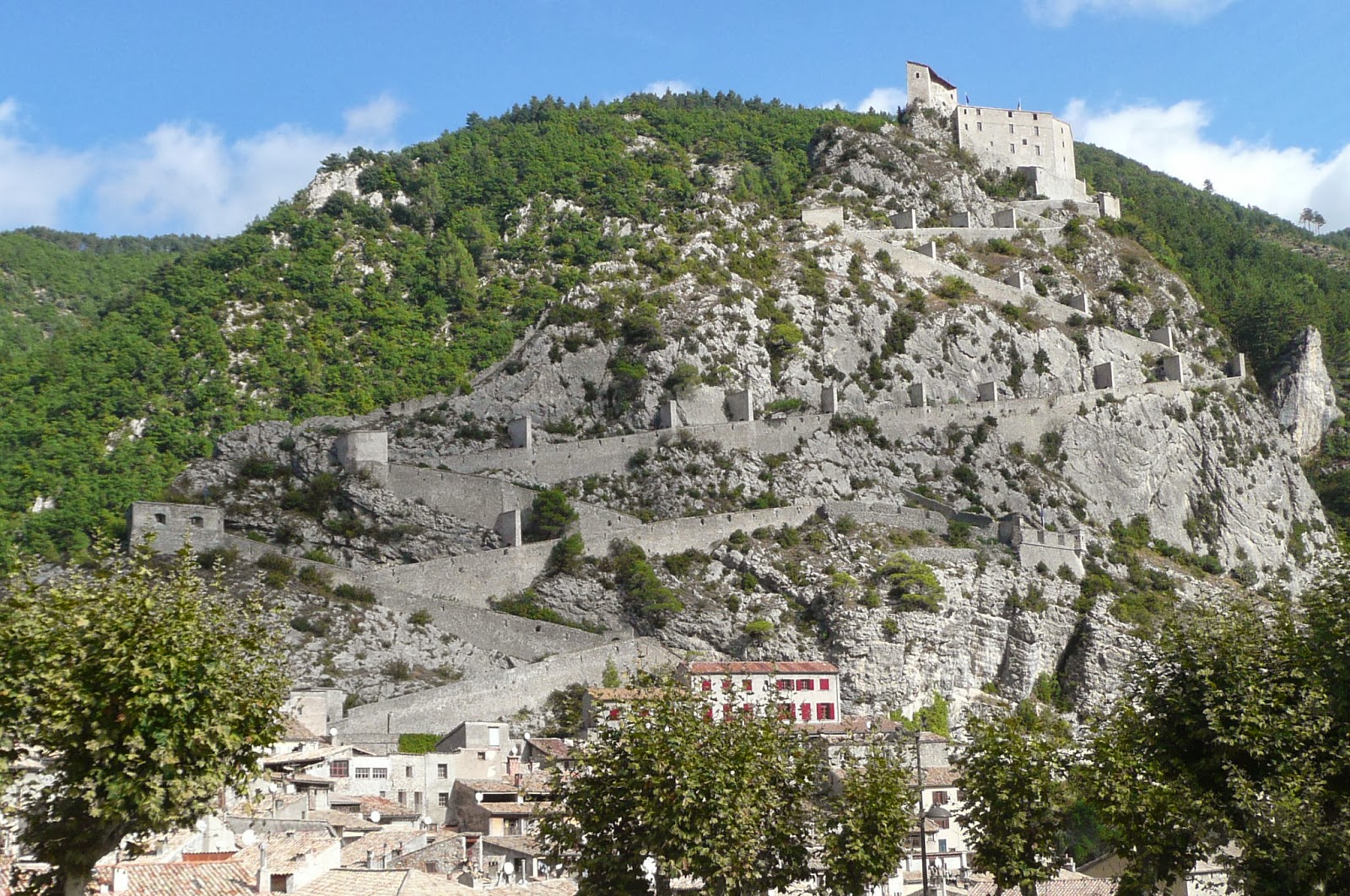
Entrevaux:


And the rest (Part Three)


 Ganagobie Abbey, which we saw only from outside:


...and the view from the top of the hill:


Annot, for our last night:


(But just because you live in an idyllic mountain town apparently doesn't mean you have to get on with your neighbours).


Entrevaux, a place that was mostly closed that day. We walked to the top of the fortress, but the reward wasn't great enough for the energy expended. It's in a state of advanced disintegration, in spite of apparent heroic restoration attempts.


This was our last day. We drove back to Nice with an accidental diversion by a tiny, horrific, and apparently endless mountain road (my fault); then struggled with getting petrol to fill the car up at the airport; then offloaded the car with some relief, and came home.


And the rest... (Part Two)


St. Michel l'Observatoire, with a beautiful old and empty church at the very top of the village:


Tasteful dustcatcher on the wall in our hotel in Oraison, the Grande Bastide, where we had another terrible mosquito encounter. This time the walls were textured, and no matter how much you hit them the mosquitoes just floated off to lurk elsewhere. We also had a strange fish incident with dinner - pricey "fresh" fish turned out to have paper slips still stuck on their underside, one with what seemed to be date of freezing on it. They took the price of the fish off the bill, but once we'd been charged separately for the cheese and dessert courses it turned out to be an expensive meal anyway. Still, I suppose at least it was a memorable one.


Forcalquier, where we should have stayed, and which was perhaps the nicest place that we saw on our trip (helped along by the fact that people still seemed to live normal lives there):


And the rest... (Part One)


The Roman theatre at Orange in the pouring rain:


The Pont du Garde:


L'Isle sur la Sorgue - watery and colourful:


Monday, December 30, 2013

Avignon and Orange

Day 5 - To Orange by way of Avignon

We left Goult and drove the short distance to Avignon. On the way out, we paused to photograph the local toilets just outside the hotel gates and next to the bus stop, which I'd noticed the night before. It brought back memories - I came to appreciate squat toilets from living in Japan, but when I was a child travelling with my parents, the French and Italian ones I encountered caused me substantial angst. They're hard to deal with when you're small and uncertain of your footing. I liked that they still had them here in Goult, though. It seems civilized to me to have free and accessible public toilets that can easily be kept clean-ish. Frankfurt is short on such things, rather like London.


The approach to Avignon is off-putting, with American style highway and sprawl, and gangs of people descending at the lights to wash your windscreen whether you want it done or not. Once we'd struggled to the historical centre and managed to park it turned out the be a pleasant place, though.

We parked close to the famous bridge, which for all its fame and song I hadn't realized would be missing a big chunk. How's that a bridge? It should clearly be called the Pier of Avignon. I was almost as disappointed as when I first went to Covent Garden and there was no garden, or Crystal Palace... or the beautiful winding silvery Serpentine that turned out to be nothing more than a muddy duckpond (it appears that London has produced a disproportionate share of disappointments for me).


We saw the papal palace from the outside, having been advised by my parents that it wasn't the most exciting thing to visit. We went to the Musée Lapidaire with its interesting collection of Roman, Egyptian and Romano-Gallic artefacts, and also visited a couple of bookshops.


And we crossed some roads...


In the afternoon we drove off (and then drove off again when we accidentally ended up back in the middle) to go to Orange, where we'd booked two nights at the Hotel Kyriad Orange Centre. This was an odd hotel - the room was probably the nicest we stayed in of our trip, modern, spacious and clean - but the hotel itself seemed to be disintegrating a little (or perhaps it was only the roof). Our room was also full of more mosquitoes than I've had to spend the night with since Taiwan, for some reason. We spent a good long time both evenings and in the middle of the night hunting them down - and all of them already full of (presumably) our blood.


Sunday, December 1, 2013

Gordes

Day 4 - Gordes
(Already two months later - I'm making this holiday last a long time.)

We visited Gordes from Goult. It was beautiful, but also not quite what I expected. There was little sense there of a living town - and it appears that much of it was in ruins until artists began to move in in the 1950s and rebuild. Now it seems to be largely a tourist town - busloads of them (us) each day, and all the businesses in the town dedicated to feeding them and selling them lavender-coloured teddy bears and soap. Or art - we did visit a small exhibition of sculptures by an artist called Alice Morlon: flattened crowds of horses and riders made of wire and mesh, looking like Celtic hunters, and strange parchment-winged angels like giant insects.


As we viewed the town from the edge - at the scenic point from which everyone stops to view it - my attention was caught by a French guide talking to her elderly American charges as if they were recalcitrant children. "Could you... just listen, because I'm not going to repeat this." Then as she told them things about the town - for instance, how expensive the houses were now - a particular lady would immediately ask the obvious questions - "So how much would a house like that be now?" The guide would respond in a voice of barely concealed irritation, "I'm just going to tell you that." What a painful trip that must have been for all involved. It seemed an odd failure of communication, too. I suspect the American lady was doing her best in her very American way to show that she was listening and to show her interest to a guide she knew was easily ruffled; while for the French guide it simply came across as impatience and ignorance. She was clearly in the wrong career.


Apart from the exhibition, the most interesting thing we did in Gordes was to visit the Caves du Palais Saint Firmin - in essence an exhibition about life and industry underground in this town. It's comprised of only a couple of vaulted rooms and their side chambers, but it was informative - lots about olive oil processing that I knew nothing about, and before that a short film that gives the history of the town. Also, there was no-one else there, and it felt special to be underground while all those busloads of people tramped around over our heads.

When we left Gordes, we went back to Goult, drove up to the windmill at the top and then picked up some supplies in a shop in the village for dinner.


Then we went back to the hotel where I had a quick swim and an evening walk.

Sunday, November 10, 2013

Castellane, Gorges de Verdon, Goult

Day 3. We left Saint-Vallier-de-Thiey with a destination already set - we'd booked a hotel online the previous night, in Goult. We got there in the end, but it was really too far for one day - or rather, there was too much in the way of winding mountain road in the first half of the journey.

We set out intending to see the Gorges du Verdon on the way; and the man in the Préjoly advised us to drive north as far as Castellane and take the road across from there so that we'd be following the gorges along. It was good advice - without it, we'd have missed Castellane, one of the nicest stops on the whole trip.

The road from Saint-Vallier-de-Thiey took us quickly into dramatic chalky-looking cliffs, with low cloud just beginning to lift. This first part was quite dramatic, but the hills became more rolling as we went on. It got particularly dramatic again when we got our first glimpse of Castellane from a hillside overlooking the valley - we could see the distinctive outcropping that towers over the town, and the tiny toy chapel perched on top of it.


I was instantly seized with the desire to climb up to the top and the anxiety that we might not do it and that my life would thus be forever incomplete. Happily I was saved from that fate. The path up (like other chapel-topped hills in the area, as I discovered later in the journey) was marked at intervals with the Stations of the Cross. The chapel at the top was full of placards thanking Our Lady of the Rock for everything imaginable - bringing back lost people, saving the town of Castellane from cholera and influenza, and so on. This is one of the strangest things about religion for me. The next town loses dozens of residents through sickness, and yours doesn't - so, it's because they didn't pray as hard, or don't have their own special protector? It seems somewhat hubristic. Anyway, if your protector is so reliable and effective, shouldn't you have prayed to them to save all of the people in the next town too... and even further afield? Did those people die because you didn't care enough to mention them? And if you invoke protection by your town goes down with cholera anyway, should you consider yourselves to be in deep disfavor, or abandoned, or... wrong? No, you presumably pray harder because your mind is only open to things that seem to support the view you've already fixed upon. It's an odd system. But it helps maintain some nice chapels, I suppose.


Here's the view of the town from above:


And the outcropping cropping out...


And the bridge bridging, with a view back to where we'd come from:


We didn't stay in the town for long - just a quick walk through and a visit to the boulangerie and minimarket to get some lunch materials, which we ate by the side of the road after we'd driven on for a while. It was a nice town, though - and it seemed to have some balance between normal town and tourist destination.


From Castellane we turned westward and started along the Gorges du Verdon. Many beautiful views, indeed, but this is where we started to make such slow progress on the map that we began to doubt making it to Goult before nightfall. This was the most dramatic view, at the Point Sublime:


We stopped briefly at Moustiers Ste. Marie, famous for its pottery, and a town clearly worth spending a little time in (at the same time, clearly a town with no tourism/normality balance at all). Unfortunately we were too tired and anxious by this time, so we merely glanced at it, grabbed a couple of highly expensive drinks and went on our way.

The rest of the drive was easier, however, and we made it to Goult before dinner. After searching in vain for our hotel for some time, we discovered that it was actually in Lumières, a hamlet attached to the village. It was the Hôtellerie Notre Dame de Lumières, which is on the grounds of a former convent, and still attached to a "sanctuary" that now belongs to some missionary sect. The hotel was great - the room (in an annex) was quite small but very clean and modern; the grounds were extensive, with an outdoor pool and a tiny chapel up a hill (complete with Stations, of course) where I communed with bats on the second evening. It had more of an air of a resort than a standard hotel, and it had the best breakfast of the trip, a sumptuous buffet with multiple mini pastries, brioche, bowls of yoghurt and conserves, and even moon cheese (well, a mysterious kind of cheese with a yellow-green flaky rind. I have no idea what it was really called).